
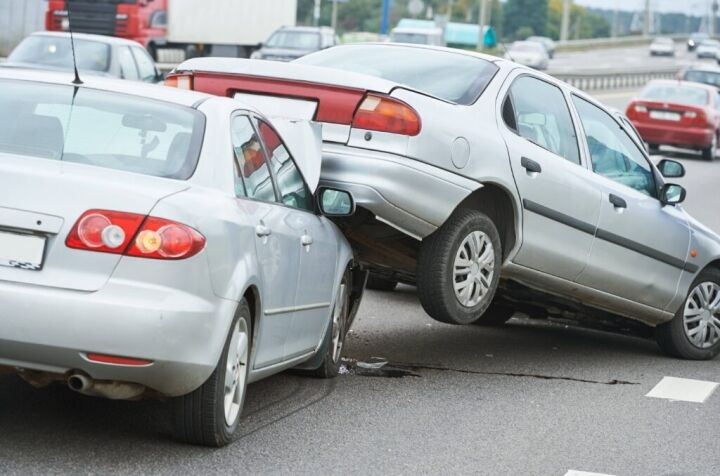
A pileup rarely has one person at fault. Several drivers may each make a small mistake. The answer to who is at fault in a multi-car pileup in California usually looks like a list of names with a percentage beside each.
Alexander Law Group, LLP represents people seriously hurt in chain-reaction crashes across Santa Clara County.
Call (408) 289-1776 to talk through your pileup with our San Jose office.
Key Takeaways About Multi-Car Pileup Liability in California
- California splits fault in a pileup among every careless driver by percentage.
- A stopped car pushed into the vehicle ahead typically carries zero fault.
- Each at-fault driver’s insurer may owe part of your damages, so one claim often becomes several.
- Your uninsured motorist coverage may pay the share owed by an uninsured driver, even when other drivers carry insurance.
How Is Fault Divided in a California Multi-Car Pileup?
Fault in a multi-car pileup in California goes to every driver whose carelessness helped cause the crash, split by percentage. California follows pure comparative fault, so you may recover damages even if you share some blame. Your recovery drops only by your own percentage.
How Does Alexander Law Group, LLP Handle Multi-Car Pileup Claims?
Alexander Law Group, LLP handles multi-car pileup claims by rebuilding the crash one impact at a time. We match each car’s damage and data to a sequence that holds up in court.
A Chain Reaction From Our Case History
On Highway 17 in Los Gatos, a Jeep slowed to make an illegal U-turn. A Housing Authority police officer driving 15 mph over the limit rear-ended the Jeep and pushed it across three lanes into our client’s car. Focus groups first blamed the Jeep for 90% of the crash.
The outcome placed 90% of the fault on the Housing Authority, and our firm recovered $5.2 million. Past results do not guarantee a similar outcome, and every case turns on its own facts.
How Do Multi-Car Pileups Happen?
Multi-car pileups happen when one sudden slowdown, impact, or loss of visibility leaves the drivers behind with too little room to stop. Around San Jose, three patterns show up again and again.
Freeway Rear-End Chain Reactions
Stop-and-go commute traffic on US-101 and Interstate 880 compresses fast near interchanges. One driver who follows too closely hits the car ahead and pushes it into the next. Vehicle Code Section 21703 bars following more closely than is reasonable and prudent.
Fog, Smoke, and Rain Pileups
Fog, wildfire smoke, or the first heavy rain of the season may cut visibility or traction in seconds. California’s basic speed law in Vehicle Code Section 22350 requires a speed that fits those conditions.
Intersection T-Bone Chains
A driver who runs a red light broadsides one car and sends it spinning into others. Cars moving in several directions make the order of impacts harder to prove.
Why Fault Is More Complicated in Multi-Vehicle Accidents
Fault is more complicated in multi-vehicle accidents because several drivers may each have contributed, and each impact may cause different injuries. The first driver often carries most of the blame. Drivers who followed may still share it.
Fault in a pileup usually sorts drivers into a few positions:
- The driver who started the chain typically carries the largest share of fault.
- Following drivers who were speeding, distracted, or too close may add their own shares.
- A fully stopped car that another vehicle pushed into a third car typically carries zero fault.
- Every injured driver and passenger may bring a separate insurance claim.
A middle driver may have a claim against the car behind while facing a claim from the car ahead.
California’s Comparative Fault Rule and Pileups
California’s comparative fault rule lets a jury give each driver in a pileup a percentage of fault. Each recovery then drops by that share. The California Supreme Court adopted this system in Li v. Yellow Cab Co. (1975), so a driver 1% at fault may recover 99% of their damages.
The example below shows how a jury might divide fault in a three-car chain crash. The numbers illustrate the math only.
| Driver | What Happened | Example Fault Share |
|---|---|---|
| Driver A | Followed too closely at freeway speed | 70% |
| Driver B | Changed lanes without enough room | 29% |
| You | Braked a moment late | 1% |
In this example, $1,000,000 in total damages leaves you $990,000 after your 1% reduction. Proposition 51, now Civil Code Section 1431.2, then decides who pays which part:
- Economic damages, like medical bills and lost wages, may come in full from any at-fault driver.
- Non-economic damages, like pain and emotional distress, follow each driver’s percentage only.
- An uninsured driver still receives a percentage, which may leave part of your non-economic damages unpaid.
Whose Insurance Pays When Multiple Drivers Are at Fault?
When multiple drivers are at fault, each at-fault driver’s insurer pays its driver’s share, up to the policy limits. California’s minimum limits are $30,000 per person and $60,000 per accident under Vehicle Code Section 16056. Several injured people may end up splitting those limits.
A pileup claim may draw on several sources at once:
- Each at-fault driver’s liability policy.
- Your own uninsured and underinsured motorist (UM/UIM) coverage under Insurance Code Section 11580.2.
- Your medical payments coverage, if your policy includes it.
- Commercial policies, when a work vehicle or truck took part in the crash.
When One Driver Has No Insurance
Your UM coverage may pay the share of fault that belongs to an uninsured driver, even when every other driver carries insurance.
UIM coverage may fill in when a driver’s limits fall short. We coordinate with every carrier at the same time, so one insurer’s early settlement does not undercut your claims against the others.
Evidence That Determines Fault in a Chain-Reaction Crash
Evidence that determines fault in a chain-reaction crash shows the order of impacts and each driver’s speed and attention. Our firm gathers evidence from every vehicle in the chain:
- Dashcam footage from any car in the pileup or from drivers who passed by.
- Crash reports from the San Jose Police Department traffic unit or the California Highway Patrol (CHP).
- Witness statements taken while memories stay fresh.
- Traffic and business surveillance cameras near the crash.
- Event data recorder (EDR), or black box, downloads from multiple vehicles.
An accident reconstruction ties these pieces together into one timeline. Vehicle Code Section 9951 limits access to EDR data without the owner’s consent, so formal requests sometimes come first.
Should You Talk to Other Drivers’ Insurance Companies?
Talking to other drivers’ insurance companies about a pileup rarely helps you, and a recorded statement may hurt you. Those adjusters work for their own drivers. Anything you say may surface in every claim tied to the crash.
Adjusters use recorded statements after a pileup in predictable ways:
- They ask you to estimate speed or distance and then treat the guess as fact.
- They press you to say you feel fine before your doctors finish testing.
- They compare your words across several claims to find small differences.
- They use a stray phrase like “I didn’t see them” to shift fault toward you.
You generally have no legal duty to give another driver’s insurer a recorded statement. Your own policy may require cooperation with your own insurer, which follows different rules.
How Do You Prove Which Impact Caused Your Injuries in a Pileup?

You prove which impact caused your injuries in a pileup by linking each injury to the timing, direction, and force of a specific collision.
Medical records, vehicle damage, and crash data work together to show that link. That proof decides which driver’s insurer pays for which harm.
Insurers in a pileup often agree that you got hurt and then argue that another driver caused it. Three kinds of proof answer that argument.
Front and Rear Damage Tell Different Stories
A car hit from behind and pushed forward often shows damage at both ends. Engineers compare the crush on each end with event data recorder (EDR) readings to measure the force of each hit. A hard rear impact followed by a light front tap points the injury toward the driver behind you.
Doctors Connect the Injury to the Force
Your treating doctors explain whether a herniated disc, brain injury, or fracture fits the direction of a particular impact. Clear notes from your first medical visits carry real weight, since insurers attack any gap in the record.
When the Injuries Overlap
Some injuries come from both impacts together and resist a clean split. California law holds a negligent driver responsible when their conduct was a substantial factor in causing the harm. A pileup accident attorney in California uses that rule to keep each insurer from pushing the whole injury onto another.
FAQ for Who Is at Fault in a Multi-Car Pileup California
Does the police report decide who is at fault in a California pileup?
No, the police report does not decide who is at fault in a California pileup. Vehicle Code Section 20013 bars using the report itself as evidence at trial. Insurers still rely on it, so a report that blames you calls for a response.
What if the driver who started the pileup drove away?
If the driver who started the pileup drove away, your uninsured motorist coverage may pay for your injuries. California generally requires physical contact with the unknown vehicle for this coverage to apply.
Does a passenger have a claim against their own driver after a pileup?
Yes, a passenger may have a claim against their own driver after a pileup if that driver’s carelessness contributed. California has no guest statute blocking these claims.
How long do I have to file a claim after a pileup in California?
You have two years to file an injury lawsuit after a pileup under Code of Civil Procedure Section 335.1. A claim involving a Valley Transportation Authority (VTA) bus or city vehicle requires a government claim within six months under Government Code Section 911.2.
Get Answers About Multi-Car Pileup Liability in California

Every driver in a pileup has an insurer, and every insurer has a reason to point at someone else. The person in the hospital bed often has the least information and the most at stake.
We look at the crash report, the vehicles involved, and your injuries. Then we explain which drivers and insurers may owe you.
Call Alexander Law Group, LLP, at (408) 289-1776 to start.
