
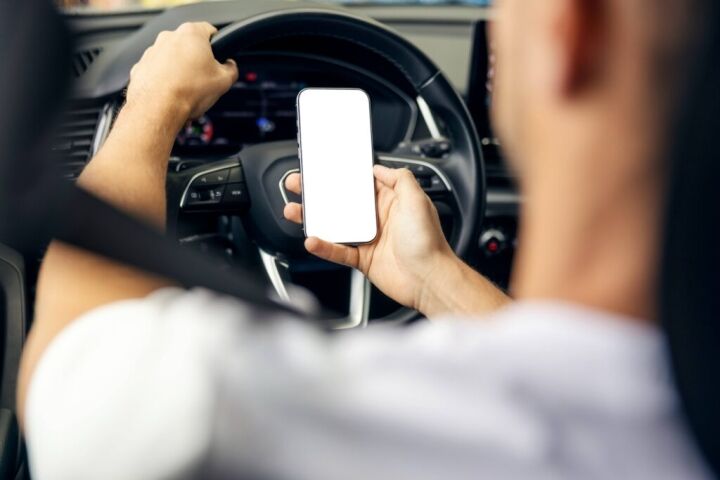
If you were hit by someone looking at a screen, California distracted driving laws matter to your accident claim in a specific and useful way. They do more than set a fine. They can change what you have to prove.
What follows covers which statutes apply, how a traffic violation turns into civil liability, and how a driver’s phone use gets established months after the crash when the driver has every reason to deny it.
Key Takeaways about Proving Distracted Driver Liability in California
- California Vehicle Code section 23123.5 prohibits drivers from holding and operating a phone or similar electronic device.
- Drivers under 18 may not use a wireless device at all, even hands free, outside of emergencies.
- Under Evidence Code section 669, violating a safety statute creates a rebuttable presumption of negligence.
- Distraction that breaks no statute, such as eating or reaching for an object, can still amount to ordinary negligence.
- Phone carrier records, application timestamps, and vehicle system data are the usual proof of device use.
What Do California’s Distracted Driving Laws Mean for Your Accident Claim?
California bars drivers from holding and operating a phone behind the wheel, and a driver who broke that law and caused your crash is presumed negligent under California’s negligence per se rule.
The presumption shifts the work onto the other driver, though it can be rebutted.
A traffic citation helps, but it is not required to prove the driver was distracted.
Phone records, app data, and vehicle data can establish what a driver was doing at impact.
Proving the violation is only part of the case, since causation and damages still have to be shown.
California’s Distracted Driving Laws at a Glance
Three Vehicle Code sections do most of the work, and they overlap rather than replace one another. Knowing which one applies matters, because the scope of each is different.
- Section 23123 bars driving while using a wireless telephone unless it is configured for hands-free listening and talking and is used that way.
- Section 23123.5 is the broad one. A driver may not hold and operate a handheld phone or other electronic wireless communications device unless it allows voice-operated, hands-free use and is used in that manner.
- Section 23124 applies to drivers under 18, who may not use a wireless device while driving in any manner, with a narrow exception for emergency calls.
Section 23123.5 is the provision most often at issue after a crash, because it reaches texting, applications, video, and mapping tools rather than phone calls alone.
What Counts as Distracted Driving Under California Law?
Holding and operating a device is the core of the violation, and the statute contains two carve-outs worth understanding. A mounted device is permitted, but only if it sits on the windshield, dashboard, or center console without blocking the view of the road, and only if the driver activates a function with a single swipe or tap.
Anything more than that single motion falls outside the exception. Scrolling, typing an address, or reading through messages on a mounted phone is still a violation.
The second carve-out is larger. Manufacturer-installed systems embedded in the vehicle are outside the statute entirely, which means a driver absorbed in a built-in touchscreen has not broken this particular law. That does not put the conduct beyond reach, as explained below.
How Does a Traffic Violation Become Legal Liability?
Through negligence per se, a rule that lets an injured person borrow a safety statute as the standard of care. California Evidence Code section 669 presumes a person failed to exercise due care when four things are established.
- The driver violated a statute, ordinance, or regulation.
- That violation proximately caused the injury.
- The injury resulted from the kind of occurrence the law was designed to prevent.
- The injured person belongs to the class the law was meant to protect.
A driver texting on Interstate 280 and rear-ending the car ahead fits all four cleanly, which is why these claims often move faster on liability than an ordinary negligence case.
One qualification gets left out of most articles on this subject. The presumption is rebuttable, not conclusive. A driver can try to show they did what a reasonable person wanting to comply with the law would have done in the same circumstances, and causation and damages still have to be proven, whatever the presumption does.
Distractions the Statutes Do Not Reach
Safety researchers group distractions into three kinds: visual, meaning eyes off the road; manual, meaning hands off the wheel; and cognitive, meaning attention somewhere other than driving. Texting is treated as the most serious because it involves all three at once, a point we cover further in our overview of distracted driving risks.
Plenty of distracted behavior breaks no statute at all. Eating, drinking, grooming, reaching into a back seat, turning to talk with passengers, and operating an embedded infotainment screen are all legal in the narrow sense.
A claim built on that conduct simply proceeds as ordinary negligence instead. The question becomes whether the driver behaved as a reasonably careful person would have, and a driver who ran a red light while unwrapping a sandwich has a difficult answer to give.
How Do You Prove a Driver Was Distracted?

You prove it with records that the driver does not control, because a driver’s own account rarely includes the phone. Several sources can be brought together and corroborate one another.
- Carrier records showing calls and data activity at the moment of impact, obtained by subpoena
- Application and mapping timestamps stored on the device itself
- Infotainment and event data recorder downloads from the vehicle
- Dashcam video, and nearby business or traffic camera footage
- Witness accounts from other drivers, passengers, and pedestrians
- The traffic collision report, including any citation and the officer’s observations
Most of this evidence has a short life, since footage is overwritten within days and carriers keep records for limited periods, so preservation letters need to go out early.
A citation issued at the scene is helpful and far from necessary. Officers do not always witness the distraction, and plenty of provable phone use never results in a ticket.
What to Do After a Crash With a Distracted Driver in San Jose
Call the police even if the damage looks minor, because the report creates a contemporaneous record against which everything else is measured. In Santa Clara County, that will usually be the San Jose Police Department or the California Highway Patrol, depending on where the crash happened.
Photograph the vehicles, their positions, the roadway, and the traffic controls. If you can see into the other vehicle safely, a photo showing a phone in a cupholder or a lit screen has real value later in a texting while driving accident claim.
Get names and numbers from witnesses before anyone leaves, and write down anything the other driver says at the scene. Admissions made in the first few minutes are often the most candid ones in the entire case.
FAQs about California Distracted Driving Laws and Accident Claims
These questions come up regularly from people trying to work out whether they have a claim worth pursuing.
Can I still recover if the other driver was never cited?
Yes. A citation is evidence, not a requirement. Liability is established in the civil case on its own record, and phone data or witness accounts can prove a distraction that no officer observed.
Is using a mounted phone legal while driving?
Only within limits. The device has to be mounted where it does not block your view, and your hand may be used for a single swipe or tap to activate or deactivate a function. Longer interactions fall outside the exception.
What if I was partly at fault?
California follows comparative fault, so a share of responsibility reduces a recovery rather than barring it. Insurers routinely argue this point, which is one reason the distraction evidence matters so much.
How do lawyers get someone else’s phone records?
Through subpoenas issued once a lawsuit is filed, directed to the carrier rather than the driver. Preservation letters sent early help keep the underlying data from being lost while the claim is still informal.
Does a hands-free call still count as a distraction?
It breaks no statute for an adult driver, but cognitive distraction is real and can support an ordinary negligence claim. The conversation still pulls attention from the road, even with both hands on the wheel.
How long do I have to file a claim?
California Code of Civil Procedure section 335.1 gives most people two years from the date of the crash to file a personal injury or wrongful death lawsuit. Shorter deadlines apply when a government entity is involved, and the electronic evidence degrades long before either one runs out.
What if the driver denies using a phone?
Denials are common and frequently contradicted by the data. Carrier records, device timestamps, and vehicle downloads do not depend on anyone’s memory, and a denial that turns out to be false tends to damage the driver’s credibility on everything else.
Talk With a San Jose Distracted Driving Accident Lawyer

Knowing the other driver was on a phone and proving it are two different things, and the gap between them narrows quickly as records age. Acting early is what preserves the proof.
Alexander Law Group, LLP, represents people with serious injuries and families who have lost someone in crashes across San Jose and Santa Clara County. Our San Jose distracted driving lawyers can send preservation letters, obtain the collision report, and tell you what the evidence actually supports.
Call (408) 289-1776 for a free case evaluation by phone or over Zoom. If you are still piecing together what happened, our San Jose car accident practice covers the broader claim.
