
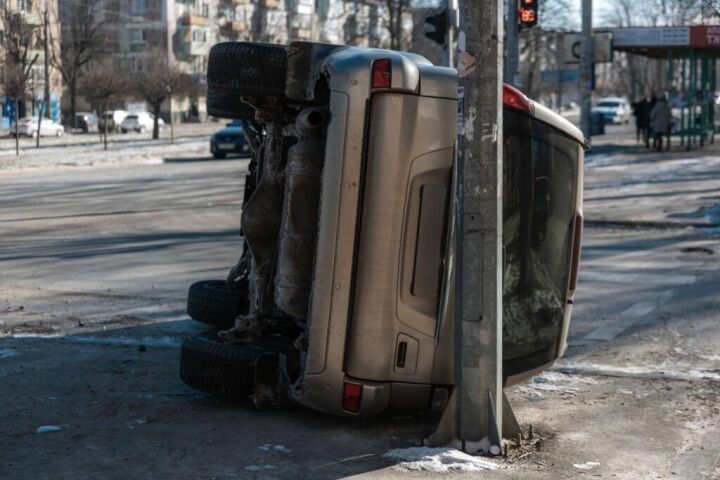
A rollover crash puts the vehicle on trial along with the driver. Roofs, seat belts, tires, and stability systems all face scrutiny after a car flips. Any one of them may shift rollover accident liability in California toward the company that built it.
Alexander Law Group, LLP handles serious rollover injury and wrongful death cases from our San Jose office, including claims against vehicle makers.
Call (408) 289-1776 before anyone moves or scraps the vehicle.
Key Takeaways for Rollover Accident Liability in California
- Rollovers fall into two types, tripped and untripped, with different likely causes.
- California holds manufacturers strictly liable for defective vehicles, so you do not have to prove the company acted carelessly.
- Roof strength, stability control, and seat belt design often decide how badly occupants get hurt.
- The wrecked vehicle is evidence, and preserving it protects the claim.
Who Pays When a Vehicle Rolls Over in California?
Rollover accident liability in California may fall on a careless driver, a vehicle or tire maker, a repair shop, or a public agency. Rollovers usually start when a tire hits a curb or soft shoulder, or when a top-heavy vehicle turns too sharply at speed. A crushed roof or failed seat belt may make the manufacturer liable even when a driver starts the roll.
What Makes a Vehicle Roll Over?
A vehicle rolls over when sideways forces lift the wheels on one side off the ground. Engineers sort rollovers into two types: tripped and untripped. The type points toward who may carry the blame.
Tripped Rollovers
A tripped rollover happens when a tire strikes something that stops the vehicle’s sideways slide. The vehicle’s momentum then carries it over.
Common trips include these:
- The tire catches a curb or raised median.
- The wheels dig into soft dirt or a steep drop-off at the road’s edge.
- The vehicle hits a guardrail end or road debris.
- Another vehicle strikes the side and shoves it sideways.
A steep pavement drop-off or missing guardrail may turn a skid into a roll, which raises road design questions.
Untripped Rollovers
An untripped rollover happens without any object, usually during a sharp turn or swerve at speed. SUVs, pickup trucks, and vans carry a higher center of gravity and face greater risk.
The National Highway Traffic Safety Administration (NHTSA) rates new vehicles for rollover risk through its 5-Star Safety Ratings program.
Around San Jose, the tight curves on Highway 17 and Mount Hamilton Road test a top-heavy vehicle’s stability.
Who May Be Liable for a Rollover Accident in California?
Liability for a rollover accident in California may rest with a driver, a manufacturer, a tire seller, a repair shop, or a public agency. Each party faces a different legal test.
| Party | Legal Theory | Key Evidence |
|---|---|---|
| Another driver | Negligence | Crash report, vehicle data, witnesses |
| Vehicle manufacturer | Strict product liability | Roof and stability testing, design records |
| Tire maker or seller | Strict liability or negligence | The failed tire and tread analysis |
| Repair shop or dealer | Negligence | Service records, inspection notes |
| Caltrans, the county, or the city | Dangerous condition of public property | Road plans, prior crash history |
Manufacturers and Strict Liability
California made manufacturers strictly liable for defective products in Greenman v. Yuba Power Products (1963). Strict liability means you may win by proving a defect caused harm, without proving carelessness. Under Barker v. Lull Engineering (1978), a jury may find a design defective when its risks outweigh its benefits.
Public Agencies and Road Conditions
Government Code Section 835 allows claims when a dangerous condition of public property causes injury. Caltrans maintains state highways, while Santa Clara County maintains its expressways and many rural roads. A claim against a public agency requires a written claim within six months under Government Code Section 911.2.
Which Vehicle Defects Show Up in Rollover Lawsuits?
Vehicle defects in rollover lawsuits usually involve the parts meant to keep occupants in a safe space. Federal Motor Vehicle Safety Standards (FMVSS) set minimum performance for many of these parts. Meeting a federal minimum does not automatically defeat a California defect claim.
The defects we see most often follow these patterns:
- Roofs crush into the cabin despite FMVSS 216a, which requires most light vehicles to support three times their unloaded weight.
- Electronic stability control (ESC), which FMVSS 126 requires on most new light vehicles, fails to prevent a slide.
- Seat belts unlatch or spool out during the roll.
- Side curtain airbags fail to deploy or deflate before the roll ends.
- Tires suffer tread separation at highway speed.
Internal testing records sometimes show a manufacturer knew about a risk and chose a cheaper design. Those records usually surface only through a lawsuit.
What Injuries Do Rollovers Cause, and How Do They Affect Liability?
Rollovers often cause head injuries, spinal cord damage, crush injuries, and ejection injuries. The injury pattern also helps prove liability, because doctors and engineers match each injury to a specific failure.
Patterns that are observed include:
- Neck and spinal cord injuries often line up with a roof crushing down onto an occupant’s head.
- Traumatic brain injuries (TBI) follow strikes against the roof, pillars, or pavement.
- Ejection injuries point to a seat belt, door latch, or window failure.
- Crush injuries to arms or hands suggest a limb caught outside a window during the roll.
A doctor who connects your spinal fracture to a crushed roof pillar gives the engineer’s opinion a human face.
How Do You Protect a Rollover Claim Before the Vehicle Disappears?

You protect a rollover claim by keeping the vehicle, its data, and its parts intact until engineers inspect them. Insurers often total a rolled vehicle and send it to a salvage auction within weeks. Once the vehicle leaves, the defect evidence leaves with it.
Our firm moves fast on preservation with steps like these:
- We send written preservation demands to your insurer, the tow yard, and the salvage company.
- We arrange storage so the vehicle stays in its post-crash condition.
- We download event data recorder (EDR) information with proper consent under Vehicle Code Section 9951.
- We keep failed tires, belts, and latches for testing.
Manufacturers defend these cases with their own engineers. A missing vehicle gives them room to blame anything except the design.
How Does Alexander Law Group Approach Rollover Liability Cases?
Alexander Law Group approaches rollover liability cases as both a crash case and a product case. We look at what made the vehicle roll and what failed to protect the people inside. Product liability claims against vehicle and tire makers sit at the center of our practice.
A Rollover Result From Our Case History
A college student died when the rear tire tread on her Ford Explorer separated and the SUV rolled several times. Her father’s dealer had noted all four tires were out of round but did not tell the family.
Our firm recovered $3 million in Pettit v. Ford. Past results do not guarantee a similar outcome, and every case turns on its own facts.
Questions We Ask in Every Rollover Case
Every rollover case has two halves, the event that started the roll and the protection that failed. We ask questions like these:
- What event started the roll?
- Did the roof hold its shape or crush into the cabin?
- Did the seat belts, side curtain airbags, and door latches work?
- Did a tire, a repair, or a road condition play a part?
A rollover that starts with driver error may still produce a strong product claim when the roof or restraints failed.
FAQ for Rollover Accident Liability California
Do I have a claim against the car maker if the rollover was partly my fault?
Yes, you may have a claim against the car maker even if the rollover was partly your fault. California recognizes crashworthiness claims, which focus on injuries a defect worsened. Your share of fault reduces the recovery by a percentage.
Does a vehicle recall help my rollover case?
Maybe. A vehicle recall may help your rollover case if the recall covers the same part that failed in your crash. You may search recalls by vehicle identification number on the NHTSA recalls page.
How long do I have to file a rollover lawsuit in California?
You have two years to file a rollover injury lawsuit in California under Code of Civil Procedure Section 335.1. Wrongful death claims follow the same two-year period from the date of death.
What if I bought the car from a private seller?
Buying the car from a private seller does not end a product claim against the manufacturer. Strict liability applies to companies in the chain of distribution, like manufacturers and dealers, rather than a neighbor who sold you a used car.
Does my family have a claim if a loved one died in a rollover?
Yes, your family may have a wrongful death claim if a loved one died in a rollover that someone else caused. Code of Civil Procedure Section 377.60 lists the family members who may file.
Protect Your Rollover Accident Liability Claim in California Today

The vehicle that rolled holds the answer to who pays, and it sits in a tow yard on someone else’s timeline. Every week raises the odds it becomes scrap metal.
Tell us where the vehicle is, who insures it, and what injuries followed.
Call Alexander Law Group, LLP, at (408) 289-1776 to start.
